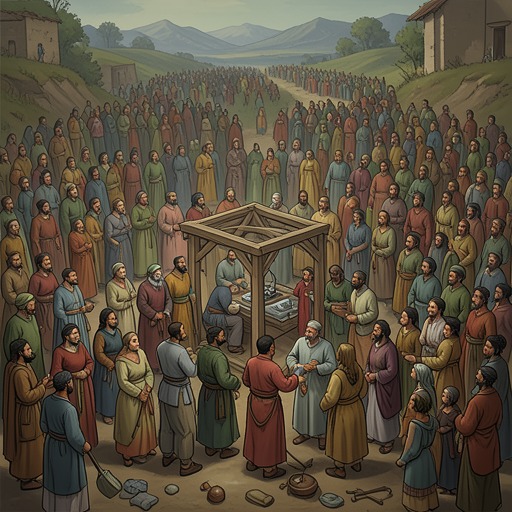
Samaritan reception of the Holy Spirit
Acts of the ApostlesThe Samaritan reception of the Holy Spirit is a turning point in Acts: people beyond the community’s previously Jewish circle welcome the Realm, are baptized, and receive the Spirit through the laying on of hands by Peter and John. Philip’s mission initiates the expansion, while the apostles’ participation connects it to the wider church. The account makes visible both the reach of the movement and the developing relationship between baptism, the Spirit, and communal recognition.
Background and Mission in Samaria
Acts presents Philip as the principal witness in Samaria. Because he is one of the seven appointed by the community, his presence signals that this mission is not simply an individual initiative: the church’s own recognized servants carry its witness across a boundary. Through Philip, God works signs, and his preaching is explicitly described as announcing the news of the Realm. The Samaritans receive that news gladly, and the account portrays the church’s power structure as supporting rather than obstructing outreach.
The episode matters in part because Samaritans were distinct from the Jewish community, despite important religious similarities. Their welcome therefore changes the composition of the community: until this point, it had been altogether Jewish; now Samaritans join its circle of disciples. The narrative’s emphasis falls not on erasing difference but on the expansion of participation. The question raised for later readers is how this welcome might direct attention to other people at the boundaries of a congregation’s familiar world.
Baptism, Apostolic Recognition, and the Spirit
When the apostles in Jerusalem hear that Samaria has received the word of God, Peter and John come to join Philip and the new converts. The account distinguishes water baptism from the reception of the Spirit: the Samaritans have been baptized, and Peter and John lay hands on them so that they may receive the Spirit. Their journey gives the Samaritan mission a visible connection to the apostolic community and confirms that the new converts belong within the movement.
This sequence is not treated as a universal timetable in which baptism and the Spirit must always arrive at the same moment. Acts includes instances in which the two occur separately as well as accounts in which they are closely joined. The text therefore preserves differing patterns rather than resolving them into one uniform procedure. Its central theological point, as presented in the commentary, is that both baptism and the Spirit are necessary for a fully empowered Christian life.
Expansion and the Shape of the Community
The Samaritan episode forms part of a broader movement outward. Philip’s preaching, the converts’ baptism, and the apostles’ laying on of hands together show how mission, communal practice, and authority interact as the church grows. The apostles’ involvement does not replace Philip’s work; instead, it joins the local witness to a larger shared responsibility. The account thus depicts an expanding community whose recognized leaders can authenticate new participation without making the original boundaries permanent.
The episode also offers a contrast with later accounts of gentile inclusion. In Samaria, the expansion adds a group that is religiously distinct from the Jewish community; elsewhere in Acts, the inclusion of gentiles raises further questions about how far people must adopt Jewish practices. Across these accounts, the community’s composition changes through concrete encounters, preaching, baptism, and reception of the Spirit. The Samaritan welcome is an early instance of that widening trajectory, not an isolated exception.
Narrative and Theological Significance
The Samaritan reception of the Spirit shows the Realm becoming present through a community that crosses inherited boundaries. Philip’s signs and proclamation initiate the welcome; Peter and John’s arrival and laying on of hands connect it to apostolic witness; baptism and the Spirit together mark the converts’ participation. Each element contributes something distinct to the episode’s account of how a new group is received.
The narrative also frames authority in relation to mission. The apostles appear on the side of outreach, joining a work already underway rather than suppressing it. The result is a community enlarged beyond its former exclusively Jewish membership and equipped for witness through the Spirit. In this account, expansion is both a change in who belongs and a demonstration that the church’s shared life must be able to recognize the Realm at its boundaries.